The Fear of Flying Relief Kit
What If the Problem Was Never Your Thoughts
And That's Why Nothing You've Tried Has Fixed It?
The Fear of Flying Relief Kit Works Directly With Your Nervous System So You Can
Get On a Plane, Stay Present Enough to Function, and Actually Get Where You Need to Go
The Fear of Flying Relief Kit™ Works Directly With Your Nervous System So You Can Get On a Plane, Stay Present Enough to Function, and Actually Get Where You Need to Go
🔒 100% Secure Checkout

What Is the Fear of Flying Relief Kit?
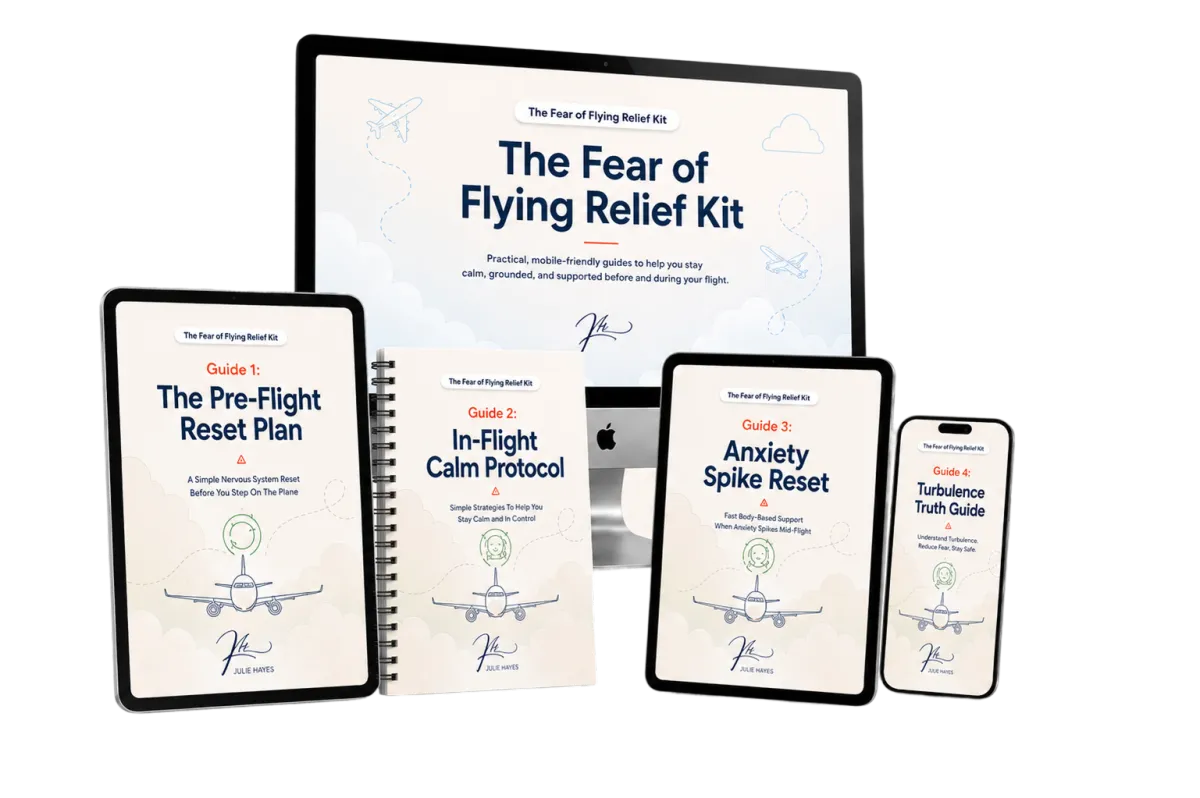
The Fear of Flying Relief Kit is a set of four practical, mobile-friendly PDF guides designed to help you know what to do before and during a flight when anxiety shows up.

Step 1: Understand what is happening in your body
Fear of flying can feel frustrating because your mind may know you are safe, while your body is still reacting as if something is wrong. The kit helps you understand that response as a nervous system response — not a weakness, not a character flaw, and not something you should be able to simply talk yourself out of.
Step 2: Use body-based tools before and during the flight
You get simple, step-by-step tools you can use in the days before your flight, while you are at the airport, once you are in your seat, and during the moments when fear spikes. The guides are designed to be clear enough to use when you are already anxious, and practical enough to keep on your phone.
Step 3: Walk onto the plane with a plan
Instead of hoping you can hold it together, you have something concrete to do. You know how to work with your nervous system before the flight, how to support yourself in the air, and how to respond when turbulence, takeoff, or the feeling of being trapped activates the fear response.
These three steps are supported by four downloadable guides: The Pre-Flight Reset Plan, The In-Flight Calm Protocol, The Anxiety Spike Reset, and The Turbulence Truth Guide.
Everything is designed for real-time use, including on flights without WiFi, so you can open the guides and follow the steps when you need them most.
There Are Two Groups of People Who Are Afraid to Fly
The First Group
The first kind lets the fear win. They cancelled the trip. They drive twelve hours instead of taking a two-hour flight.
They watch their family board a plane and stay behind.
They tell themselves they'll deal with it someday — and someday never comes.
Only to miss out on memories.
The Second Group
They grip the armrest. They count the minutes. They watch the flight attendants' faces for any sign that something is wrong. They talk themselves through every sound, every bump, every shift in altitude.
They survive the flight — and then spend the next few days recovering from the experience of surviving it.
You Already Know the Statistics. And They
Haven't Helped.
You Already Know the Statistics. And They Haven't Helped.
You've Googled it.
You know flying is statistically one of the safest forms of travel.
You know the odds.
You know planes are built to handle turbulence. You know pilots train for years. You know all of this.
And yet — the moment that boarding announcement comes over the speaker, something happens in your body that no statistic has ever been able to stop.
Your chest tightens. Your heart picks up speed. Your mind starts scanning for everything that could go wrong. And by the time you're sitting in that seat, watching the door close, feeling the plane begin to move — you're not thinking about statistics anymore.
You're just trying to get through the next few hours.
The Anxiety Doesn't Start at the Airport
And That's the Part Nobody Talks About
For most people who struggle with flight anxiety, the hardest part isn't even the flight itself. It's the weeks before. The moment a flight gets booked, something shifts.
It starts quietly — a low hum of dread in the background of your day. You find yourself thinking about it while you're trying to fall asleep. You check the weather forecast for your travel day even though it's three weeks out. You run through scenarios. You wonder if this will be the time you completely fall apart.
By the time you actually get to the airport, you've already been living with this for days.
You're exhausted before you've even boarded. And then the flight itself begins. Every sound the plane makes becomes something to interpret. Every bit of turbulence — even the mild, completely routine kind — sends a jolt of adrenaline through your body. You grip the armrest.
✅ You watch the flight attendants' faces.
✅ You count the minutes.
✅ You try to breathe.
✅ You try to distract yourself with a movie or a podcast.
✅ You try to just hold it together until it's over.
And sometimes you do hold it together. But holding it together isn't the same as feeling okay. And you know that.
You've Already Tried the Things People Tell You to Try
You've read about flight safety.
You've downloaded meditation apps.
You've tried deep breathing.
You've had a drink at the airport to take the edge off.
You've watched videos explaining how planes work.
You've talked yourself through it logically, over and over again, reminding yourself of every reassuring fact you can remember.
And maybe some of those things helped a little. Maybe they took the edge off just enough to get you through. But they didn't fix it. Because the next flight came around, and the whole cycle started again.
The anticipatory dread. The sleepless nights. The white-knuckling. The relief when it was finally over — followed by the quiet dread of knowing you'll have to do it again someday.
That cycle is exhausting.
And it's not because you're not trying hard enough. It's because everything you've tried has been aimed at your thoughts. And the fear doesn't actually live there.
Every Flight You Dread Is Costing
You More Than You Realize
Every Flight You Dread Is Costing You More Than You Realize
Think about what this fear has already taken from you. The vacation you talked yourself out of because the flight felt like too much. The family trip where you spent the entire journey gripping the armrest instead of being present.
The work opportunity you hesitated on because it required travel. The version of your life where you move through the world freely — without a flight being something you have to mentally prepare for weeks in advance.
This isn't just about being uncomfortable on a plane. It's about the life that's waiting on the other side of this fear — and how much of it you've already put on hold.
What If the Problem Was Never Your Mindset?
Here's something that changes everything once you understand it.
Fear of flying isn't a thinking problem. It's a body problem. When your nervous system perceives a threat — real or imagined — it doesn't wait for your logical mind to weigh in.
→ It acts immediately.
→ It floods your body with adrenaline.
→ It tightens your muscles.
→ It speeds up your heart.
→ It narrows your focus and puts you on high alert.
This is your survival system doing exactly what it was built to do. The problem is that your survival system doesn't know the difference between a genuine threat and a Tuesday afternoon flight to see your family. It responds the same way to both.
And here's the part that matters most:
You cannot think your way out of a nervous system response.
That's not a personal failing.
That's not a character flaw.
That's just how the brain and body work.
The part of your brain running the fear response — the part flooding you with adrenaline and telling you something is wrong — is not the part that processes logic and statistics.
Those are two completely different systems.
So when you try to calm yourself down by reminding yourself that flying is safe, you're trying to solve a body problem with your mind. And the body doesn't respond to that.
What the body does respond to — what actually reaches the nervous system and begins to shift the fear response — is something different entirely.
It's body-based. It's direct. And it works in real time, even when you're already in the middle of a fear spiral.
This Is Why Smart, Self-Aware, High- Functioning People Still Struggle With This
This Is Why Smart, Self-Aware, High-
Functioning People Still Struggle With This
And maybe some of those things helped a little. Maybe they took the edge off just enough to get you through. But they didn't fix it. Because the next flight came around, and the whole cycle started again.
The anticipatory dread. The sleepless nights. The white-knuckling. The relief when it was finally over — followed by the quiet dread of knowing you'll have to do it again someday.
That cycle is exhausting.
And it's not because you're not trying hard enough. It's because everything you've tried has been aimed at your thoughts. And the fear doesn't actually live there.
START READING HERE
You're not someone who lacks self-awareness. You probably understand your anxiety better than most people understand theirs.
You've read about it.
You've thought about it. You may have even worked on it in therapy.
And you still feel it on the plane. That's not a failure of effort or intelligence.
That's what happens when you're using the right tools for the wrong problem. The tools that work for thought-based anxiety journaling, reframing, cognitive techniques don't reach the nervous system the way body-based tools do.
And flight anxiety, at its core, is a nervous system response.
Once you have tools that speak the language your body actually understands, everything shifts.
Not because the fear disappears entirely. But because you stop being at its mercy.
I've Seen This Fear From Both Sides
And That's Exactly Why I Built This

My name is Kelly, and before I tell you about the Fear of Flying Relief Kit, I want to tell you where it came from. Because I think it matters.
Before I became a therapist, I was a flight attendant.
Aviation wasn't just a job for me — it was part of my family. My mother was a flight attendant. My father was a pilot. Being in the air felt as natural to me as being in a car.
I grew up around planes, around airports, around the rhythms of that world. But what I remember most from my years as a flight attendant wasn't the flying. It was the passengers.
I Watched Strong, Capable People White-Knuckle Their Way Through Flights That Were Completely Fine. I would watch people board the plane — professionals, parents, clearly intelligent and accomplished individuals — and I could see it on them before they even sat down.
The tension in their shoulders.
The way they gripped their carry-on a little too tightly.
The way their eyes moved around the cabin, looking for something they couldn't quite name.
Sometimes they would pull me aside quietly, before we pushed back from the gate.
→ "Can you tell me when the turbulence will start?"
→ "Is this a safe plane?"
→ "I know this sounds silly… but I'm really scared."
It never sounded silly to me. And it wasn't just one type of person. I watched women grip the armrest through flights that were completely smooth. I watched businessmen in suits — people who projected total confidence in every other area of their lives — quietly managing their own terror from the window seat.
I watched parents distract their kids with iPads while their own hearts were racing. I watched people who looked completely composed on the outside counting the minutes until landing on the inside.
Fear of flying doesn't care who you are, what you do, or how capable you look from the outside. It shows up for everyone. These weren't fragile people.
These were strong, accomplished, fully functioning adults — and they were suffering in a way that nobody around them could really see.
I thought about those passengers a lot over the years.
Then September 11th Happened — And Fear Stopped Being Something I Only Observed in Others. Both of my parents were in the air that day.
My mother was a flight attendant. My father was a pilot. I don't need to tell you what that day felt like for the world. But I can tell you what it felt like to be someone whose entire family lived in the sky — and to spend those hours not knowing.
For the first time in my life, fear wasn't something I watched from the other side of the aisle. It was something I felt in my own body. Deeply. Completely. That experience changed my relationship with flying.
It changed my relationship with fear. And it changed the direction of my life. Not long after, I stepped away from aviation.
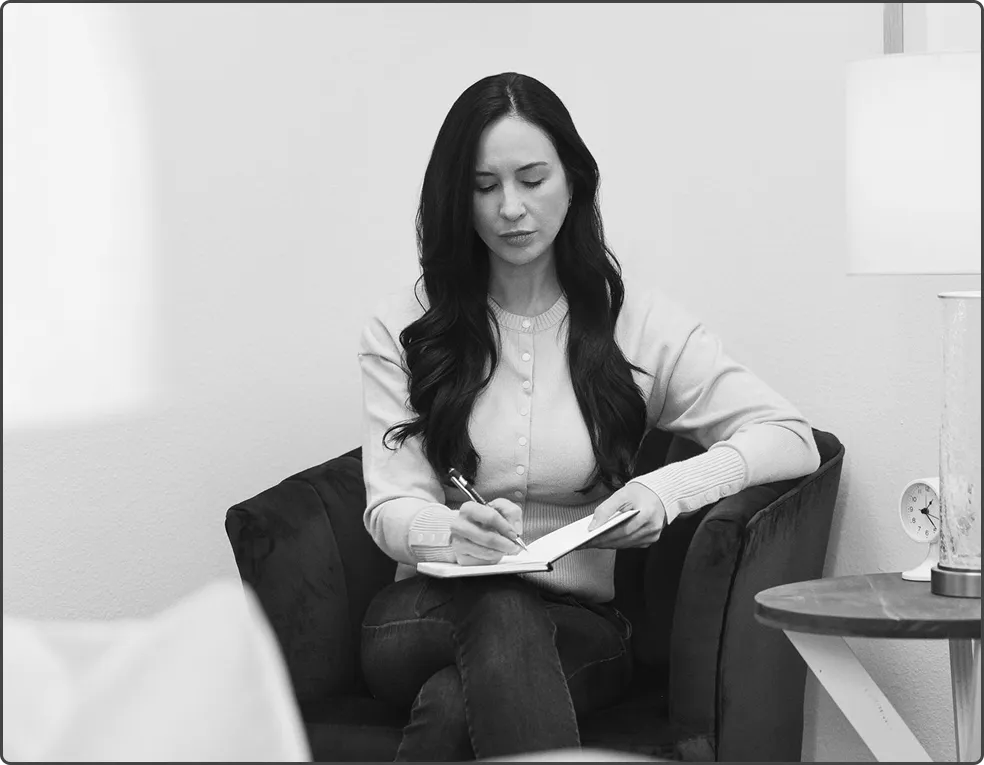
Years Later, I Became a Therapist — And Found the Same Fear Waiting for Me There Too. After going through my own significant life transitions, I went back to school and became a therapist.
And once again, I found myself sitting across from people who were experiencing that same familiar fear I had watched for years on planes.
Smart, capable, self-aware people who knew — logically — that they were safe. But whose bodies weren't responding to that knowledge.
Through my training in counseling and neuroscience-informed approaches, including EMDR-based principles, I learned something that finally made sense of everything I had witnessed:
Fear doesn't live in the mind alone. It lives in the body. And when the body is in survival mode, logic doesn't reach it. What does reach it — what actually works — are techniques that speak directly to the nervous system.
✅ Body-based approaches. ✅ Bilateral stimulation. ✅ Grounding.
Real-time regulation tools that work in the moment, not just in theory. When I started using these tools with clients, the shift was real and it was immediate.
People didn't just understand their fear differently. They could actually move through it.
That's Why I Created the Fear of Flying Relief Kit
Not to give you more information about why flying is safe.
Not to tell you to just breathe and think positive thoughts.
But to give you something that actually works when the fear shows up — tools that speak the language your nervous system understands, so you can get on the plane, stay present enough to function, and get where you need to go.
Get The Fear of Flying Relief Kit - Just $27

Get Instant Digital Access

🔒100% Secure 256-Bit Security Encryption
What People Are Saying After Using The Fear Reset Starter Kit
⭐⭐⭐⭐⭐
I didn’t expect much the first time I tried it, but within about a minute my shoulders dropped and my breathing changed. The fear didn’t magically disappear, but my body stopped feeling like it was bracing for something. That alone felt huge.
- Sarah.
⭐⭐⭐⭐⭐
I’ve done mindset work, journaling, meditation — all of it helped to a point. This was the first thing that actually helped when my body felt stuck in stress. It gave me something practical to use in the moment instead of just trying to think my way out.
- Emily.
⭐⭐⭐⭐⭐
I noticed the biggest difference when I used this before making a decision I’d been avoiding. Once my body settled, my thoughts felt clearer. I didn’t spiral the way I usually do — I could actually decide and move on.
- Lauren.
⭐⭐⭐⭐⭐
I used this the first time I woke up in the middle of the night with my mind racing. It helped my body calm enough that I could fall back asleep instead of lying there spiraling for hours.
-Megan.
Introducing
The Fear of Flying Relief Kit
The Body-Based Relief System for Anyone Who Knows
they're Safe But Can't Get Their Body to Believe It
The Body-Based Relief System for Anyone Who Knows They're Safe But Can't Get Their Body to Believe It
The Fear of Flying Relief Kit is a set of four practical, immediately accessible PDF guides built around one core principle:
❌ Your nervous system can be calmed. ❌ Not by thinking harder. ❌ Not by knowing more.
✅ But by using the right tools — tools that work directly with your body's fear response, in real time, wherever you are.
This is not a course. It's not a program that requires weeks of preparation before it does anything for you. It's not something you have to complete before your next flight.
It's a kit. Something you can open today, use this week, and feel working — before your next flight and on it. It's designed to be simple enough to use when you're already anxious. Because that's exactly when you need it most.
Why This Works When Other Things Haven't
Most approaches to flight anxiety try to change what you're thinking.
The Fear of Flying Relief Kit works differently. It's built around what we call the Body-Mind Fear Override — a nervous system-based approach that bypasses the logical mind and works directly with your body's fear response.
Instead of trying to convince your brain that you're safe, these tools use bilateral stimulation, grounding techniques, and real-time regulation methods to communicate safety directly to your nervous system — in the language it actually understands.
This is the same foundational approach used in trauma-informed therapy.
And it works for flight anxiety because flight anxiety, at its core, is a nervous system response — not a thinking problem.
Everything Inside the Fear of Flying Relief Kit
📋 Guide 1: The Pre-Flight Reset Plan
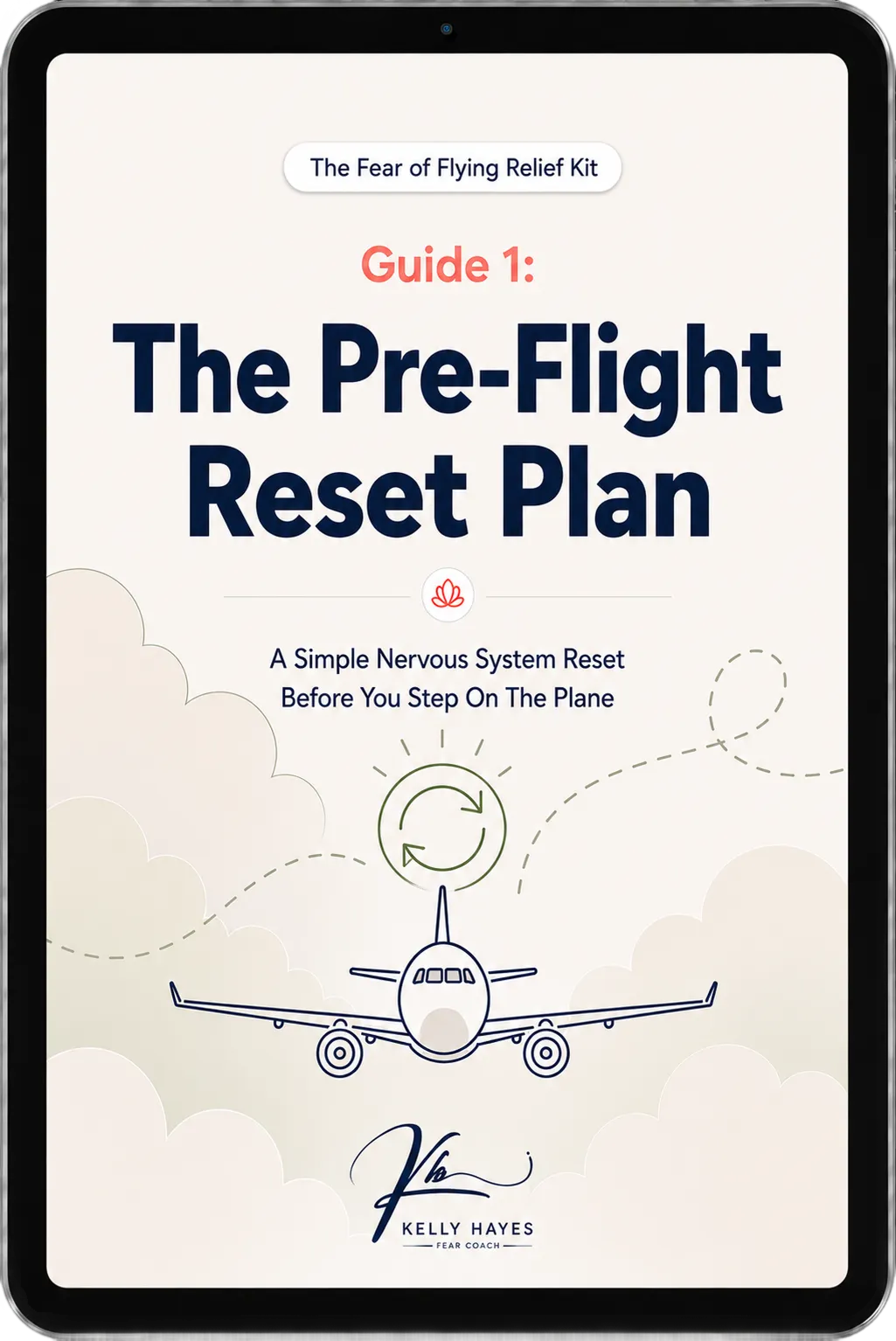
For the days before your flight — when the dread starts building and you need something to do with it. The anxiety doesn't start at the airport. For most people, it starts the moment a flight gets booked — sometimes days or weeks before you ever step foot in a terminal.
The Pre-Flight Reset Plan is designed specifically for that window.
It gives you a clear, step-by-step approach to calming your nervous system in the days leading up to your flight, so you're not arriving at the airport already exhausted from a week of anticipatory dread.
It helps you interrupt the anxiety spiral before it builds momentum.
It gives you something concrete and effective to do with the fear — instead of just sitting inside it and hoping it passes.
You'll arrive at the gate feeling more prepared and more grounded. Not fearless but ready.
✈️ Guide 2: The In-Flight Calm Protocol
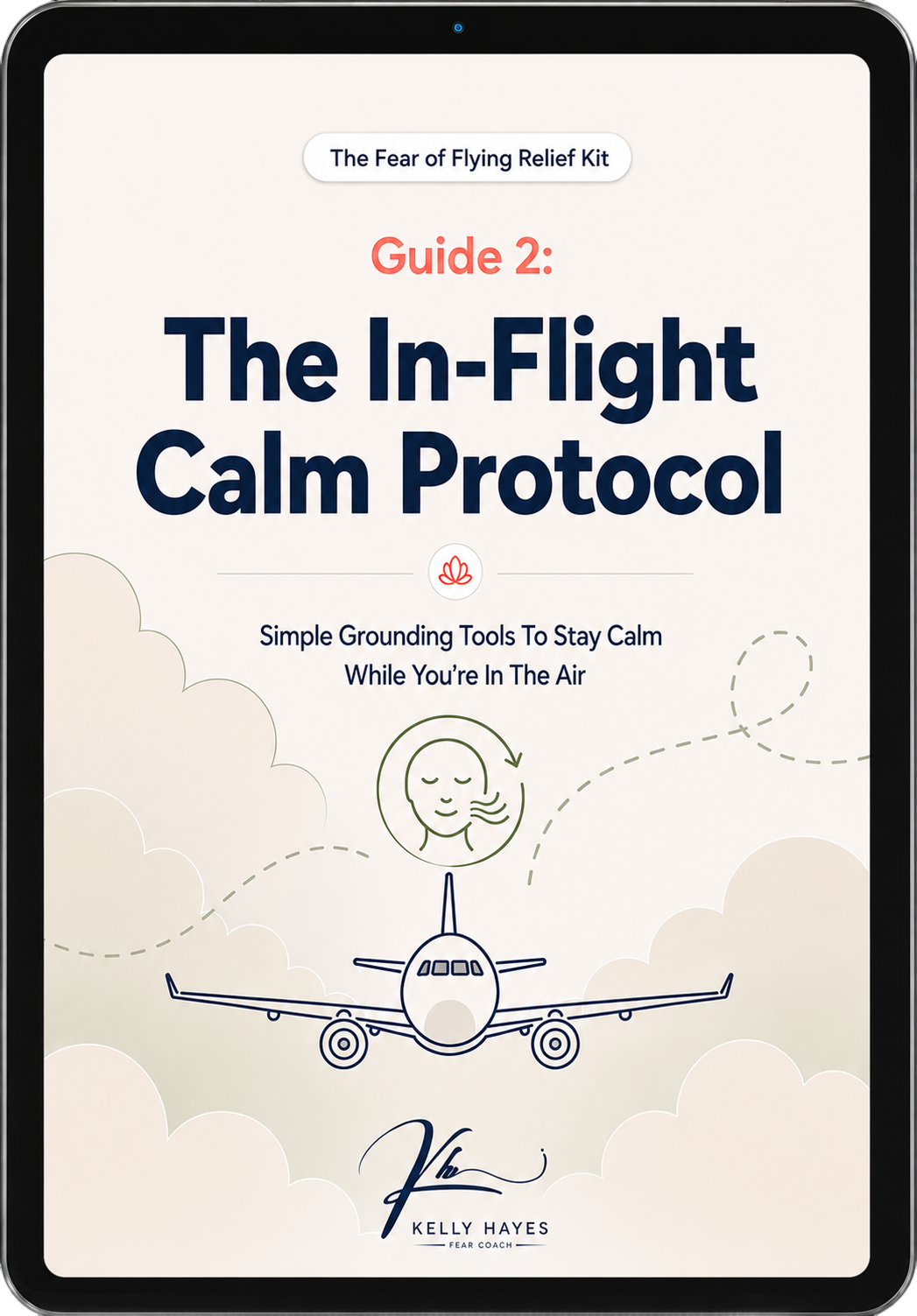
For the flight itself — a step-by-step guide you can follow in real time when anxiety starts to rise. This is your on-the-plane guide.
It walks you through exactly what to do when anxiety begins to build while you're in the air — step by step, in plain language, without requiring you to remember a complicated technique while your heart is already racing.
It includes grounding techniques, breathwork that works with your nervous system rather than against it, and bilateral stimulation — a left-right tapping approach that helps your brain shift out of the fear response and back into a regulated state.
This guide is designed to be used on the plane, including during flights without WiFi. You don't need a signal.
You don't need to stream anything.
You open the guide, you follow the steps, and you give your nervous system something to work with.
⚡ Guide 3: The Anxiety Spike Reset
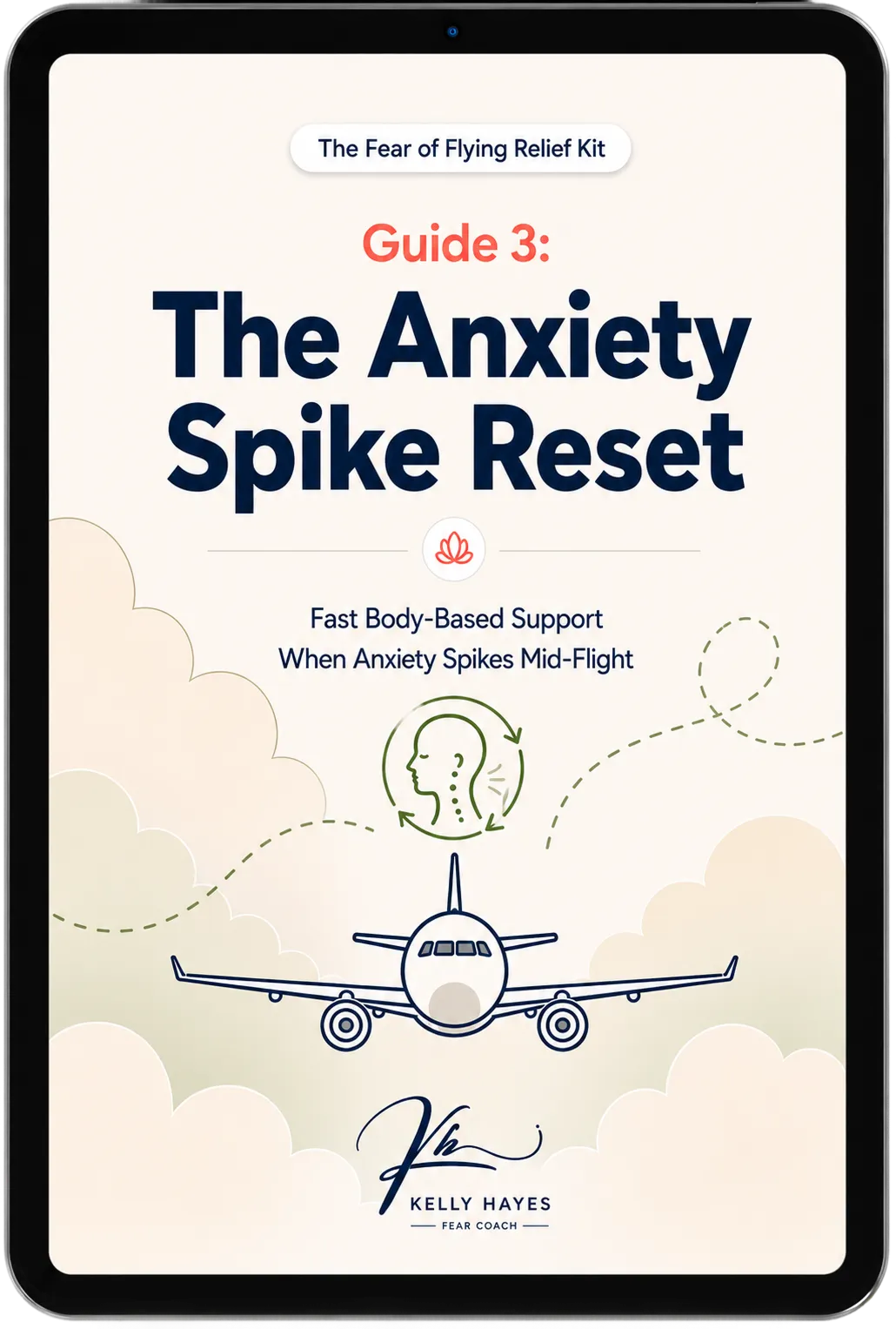
For the moments when fear doesn't just rise — it spikes — and you need something that works fast. This one is for the moments that feel unmanageable.
The sudden jolt of turbulence. The unexpected sound. The moment where everything in your body goes to high alert and you feel like you're losing control of yourself.
The Anxiety Spike Reset gives you a fast, structured tool for exactly those moments.
It's built around bilateral stimulation — a left-right tapping technique grounded in the same principles used in trauma-informed therapy — and it's designed to help your nervous system come back down quickly, even when the fear feels overwhelming.
This isn't about suppressing the fear or pretending it isn't there. It's about giving your body a clear, direct path through it — so that the spike doesn't have to become a spiral.
🌪️ Guide 4: The Turbulence Truth Guide
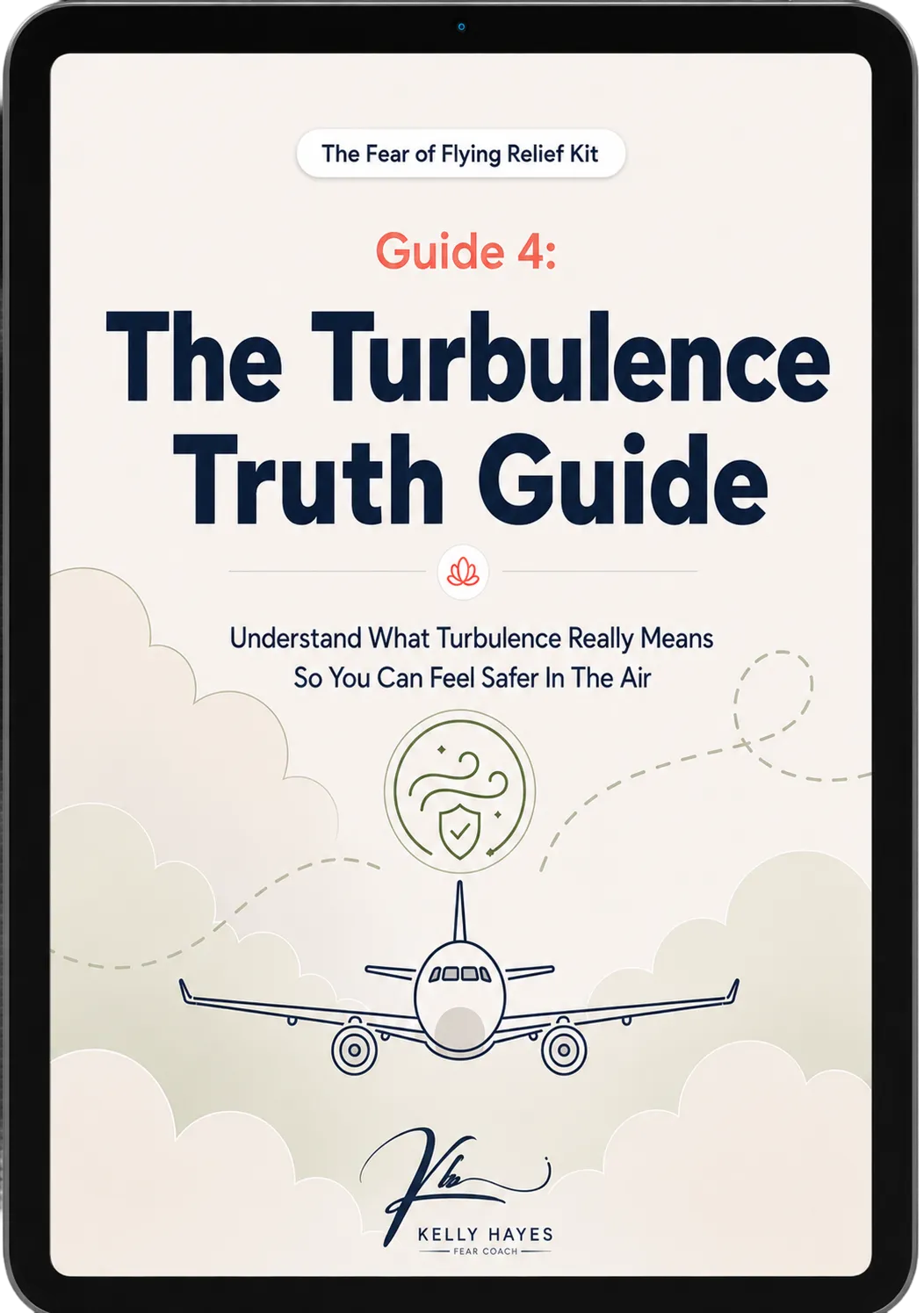
For the part of flying that triggers most people the most — and why understanding it changes everything. For many people with flight anxiety, turbulence is the single most terrifying part of flying. Not because of what it actually is — but because of what the body interprets it to be.
The sudden drops The shaking. The sounds the plane makes when it moves through rough air. Every one of those sensations gets filtered through a nervous system that is already on high alert — and the result is a level of terror that feels completely out of proportion to what's actually happening.
The Turbulence Truth Guide gives you clear, honest, reassuring information about what turbulence actually is, what causes it, what it means, and — just as importantly — what it doesn't mean. It's written in a way that's designed to reach you even when your nervous system is already activated, so the information actually lands instead of just bouncing off the fear.
This guide helps you reframe what you're feeling in your body during turbulence, so that the physical sensations become less threatening and more manageable. It won't make turbulence comfortable for everyone. But it can take the terror out of it — and that changes the entire experience of being on a plane.
This Kit Was Made for You If Any of
This Sounds Familiar
This Kit Was Made for You If Any of This Sounds Familiar
You have a flight coming up — a vacation, a family visit, a work trip, an event that matters to you — and the anxiety is already starting to build. You need something real and practical that you can use now, not something that takes months to work.
You've tried the logical approach. You've read the statistics. You've told yourself it's safe. You've done the deep breathing. And your body still doesn't believe it when you're actually on the plane.
You're not looking for a long program or a months-long process. You need tools you can use now, on your next flight, in the moments when the fear shows up.
You're tired of white-knuckling your way through flights and just surviving them. You want to actually feel like you have some control over what happens in your body when the anxiety rises.
You want to be able to travel freely. For the vacation you've been putting off. For the family event you don't want to miss. For the work trip you've been dreading. For the version of your life where getting on a plane is something you can do — not something you have to recover from.
And Just to Be Clear About Who This Is Not For
This kit is not a replacement for therapy or clinical treatment. If you're working through significant trauma or a diagnosed anxiety disorder, please continue working with a mental health professional that support matters and this kit is not designed to replace it.
What this kit is is a set of real, body-based tools that you can use right now, on your own, to start shifting your experience of flying. Tools built by someone who has spent years on both sides of this fear — as a flight attendant who witnessed it up close, and as a therapist trained in the approaches that actually address it at the root.

Picture What Flying Could Actually Look Like for You
Think about your next flight.
❌ Not the version where you spend three weeks dreading it.
❌ Not the version where you arrive at the airport already depleted from days of anticipatory anxiety.
❌ Not the version where you grip the armrest and count the minutes and feel like you're just barely holding it together until the wheels touch down.
A different version.
→ You book the flight and yes — there's some nervousness.
→ That's honest.
→ That's real.
But it doesn't take over the way it normally does. Because this time, you have a plan.
You know what you're going to do in the days before, and you know what you're going to do if anxiety rises on the plane.
That knowledge alone changes something. The dread doesn't spiral the way it used to because you're not walking into this empty-handed anymore.
The night before the flight, you sleep. Not perfectly — but you sleep. Because instead of lying there running through worst-case scenarios, you work through your Pre-Flight Reset Plan.
You give your nervous system something to work with. You wake up the next morning tired maybe, but not already wrecked.
→ At the airport, you feel the familiar flutter of anxiety.
→ But it doesn't escalate the way it normally does.
→ You have your guides on your phone.
→ You know exactly what to do if things get harder.
→ You board the plane.
→ You find your seat.
→ You feel your heart rate pick up as the door closes — and instead of bracing against it and hoping it passes, you open your In-Flight Calm Protocol and you start working through it.
Step by step. Your breathing shifts. Your body begins to settle, just slightly.
Not completely calm — but no longer in full survival mode either.
The plane takes off. Somewhere over the middle of the country, there's turbulence — the kind that used to send you into a full spiral.
→ Your body reacts
→ Of course it does.
→ But this time, you reach for the Anxiety Spike Reset.
You do the tapping. Left, right, left, right. And something shifts.
The spike doesn't become a spiral. You come back down. You look out the window. You land.
And for the first time in a long time, you don't feel like you need to recover from the experience of getting somewhere.
You feel like someone who handled it. Someone who had tools and used them. Someone who knows — not just hopes, but actually knows — that they can do this again.
That's not a fantasy. That's what having the right tools actually makes possible.
Think About Where You Want to Go
There's a trip you've been putting off. Maybe it's been sitting in the back of your mind for a while now — a place you want to see, a person you want to visit, an experience you've been telling yourself you'll get to someday when you feel ready.
The only thing standing between you and that trip is a few hours on a plane. And the only thing making those few hours feel impossible is not having the right tools for what your body does when it gets scared.
That's a solvable problem. And you're looking at the solution right now.
Here's What This Is Worth
And What It Actually Costs
Let's be honest about something for a moment.
The cost of not having these tools isn't zero.
Every trip you've cancelled because the anxiety felt like too much — that has a cost.
Every vacation you've talked yourself out of, every family event you've dreaded for weeks, every flight you've white-knuckled through and then needed days to recover from — those have a cost.
Not just financially, but in the quality of your life and the experiences you've said no to because of this fear.
Some people spend hundreds of dollars on therapy specifically to address flight anxiety.
A single session with a therapist who specializes in anxiety typically runs anywhere from $150 to $250.
And while therapy is valuable, a single session isn't going to give you a toolkit you can pull out on a plane at 35,000 feet when turbulence hits and your heart is racing.
Some people spend money on medication.
Some spend money on drinks at the airport bar.
Some spend money on noise-canceling headphones, on sleep aids, on anything that might take the edge off — and still land feeling like they barely survived.
The Fear of Flying Relief Kit is $27.
Twenty-seven dollars for four guides built by someone who spent years as a flight attendant watching this fear up close — and then spent years as a therapist learning the body-based approaches that actually address it at the root.
Twenty-seven dollars for tools you can use before your next flight, on your next flight, and every flight after that.
Twenty-seven dollars to stop walking onto a plane empty-handed.
When you think about the trip you've been putting off — the vacation, the family visit, the experience you keep saying someday to — and you think about what it would mean to actually go, to actually be present for it, to actually feel like you handled it rather than just survived it.
Twenty-seven dollars is not the question. The question is whether you're ready to stop letting this fear decide what your life looks like.
Here's Everything You Get When You Download
The Fear of Flying Relief Kit Today
Here's Everything You Get When You Download The Fear of Flying Relief Kit™ Today
📋 The Pre-Flight Reset Plan — The step-by-step guide to calming your nervous system in the days before your flight, so you stop arriving at the airport already depleted from weeks of dread
✈️ The In-Flight Calm Protocol — Your real-time, step-by-step guide for managing anxiety while you're on the plane, including grounding techniques, breathwork, and bilateral stimulation — works without WiFi
⚡ The Anxiety Spike Reset — The fast-acting tool for moments when fear spikes suddenly and you need something that works immediately, built around the same bilateral stimulation principles used in trauma-informed therapy
🌪️ The Turbulence Truth Guide — Clear, honest, reassuring education about turbulence that helps you reframe what your body is feeling so the sensations become less threatening and more manageable
All Four Guides Are:
Instantly downloadable the moment you purchase
Mobile-friendly so you can access them from your phone on the plane
Designed for real-time use — meaning you can open them mid-flight and follow along even when anxiety is already present
Written in plain, clear language — no clinical jargon, no complicated techniques that require weeks of practice before they do anything

You're Not Taking a Risk Here I Am
I want you to feel completely confident picking this up today. So here's my promise to you:
If you download the Fear of Flying Relief Kit, work through the guides, use the tools, and feel that they haven't given you anything genuinely useful — just reach out within 30 days of your purchase and I'll refund every penny.
❌ No complicated process.
❌ No questions designed to talk you out of it.
❌ No hoops to jump through.
Just a straightforward refund, processed promptly. I'm making this promise because I believe in what's inside this kit. I've seen what these tools do for people who have tried everything else and still felt stuck.
I know what it means to finally have something that actually reaches the nervous system instead of just talking at it. If it doesn't do that for you — you shouldn't pay for it. The only way you can lose here is by not trying it at all.
There's No Artificial Deadline Here But There Is a Real One
I'm not going to tell you this offer expires at midnight or that there are only a limited number of copies left. That's not true and it wouldn't be fair to you.
But here's what is true:
You have a flight coming up. Or one is coming — whether it's booked yet or not. A vacation. A family visit.
A work trip. → An event that matters to you. → And right now, in this moment, you have the chance to go into that flight with something you've never had before — a real, body-based toolkit that gives you something to do when the fear shows up.
The window that matters isn't an artificial countdown timer.
It's the gap between now and your next flight. Every day you wait is another day of carrying this without the tools to manage it. Another day of the anticipatory dread building quietly in the background. Another day of telling yourself you'll figure it out — while the flight gets closer and the anxiety gets louder.
You don't have to white-knuckle your way through another one. The kit is here. It's ready. And so are you.
You're Standing at a Fork in the Road Right Now
Not dramatically. Not in a way that requires a big speech. But genuinely — right now, in this moment — you have two directions you can go from here. And I want to be honest with you about what both of them actually look like.
Path One: You close this page without the kit.
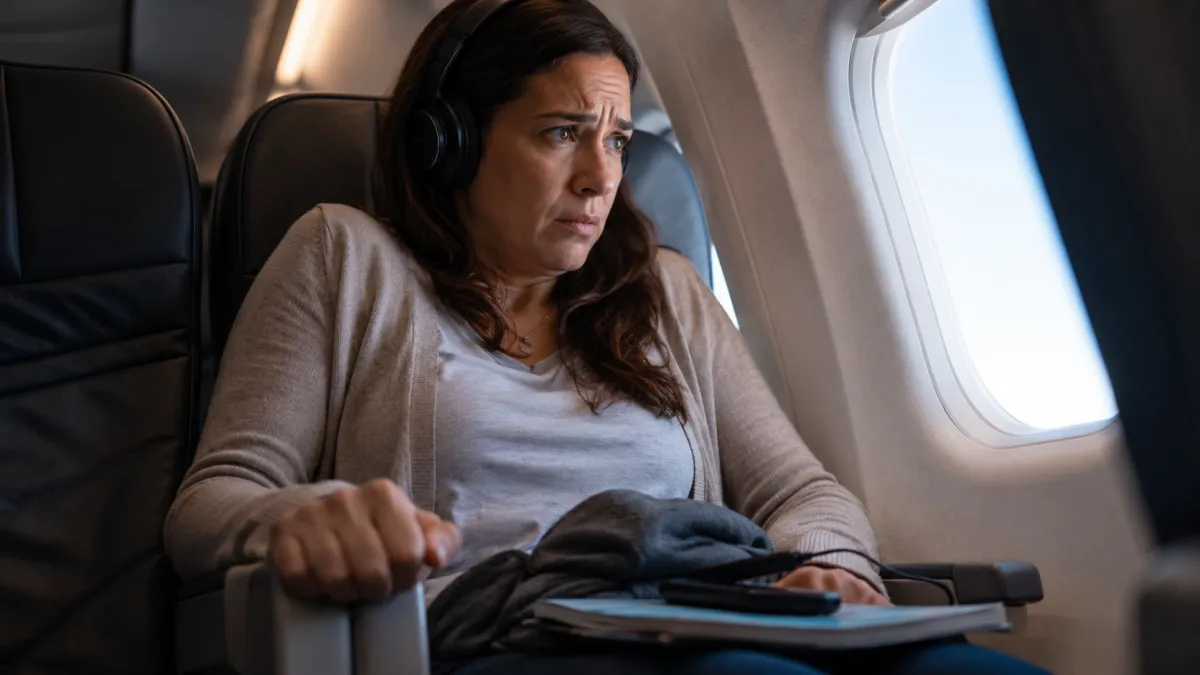
Your next flight is still coming. The weeks before will look the way they always look. The low hum of dread. The sleepless nights. The morning of the flight where you wake up already tense.
You board the plane. You grip the armrest. You count the minutes. You land. You feel relief.
And then, somewhere in the back of your mind, you start thinking about the next one. Nothing changes. Because nothing changed.
Path Two: You download the Fear of Flying Relief Kit today.
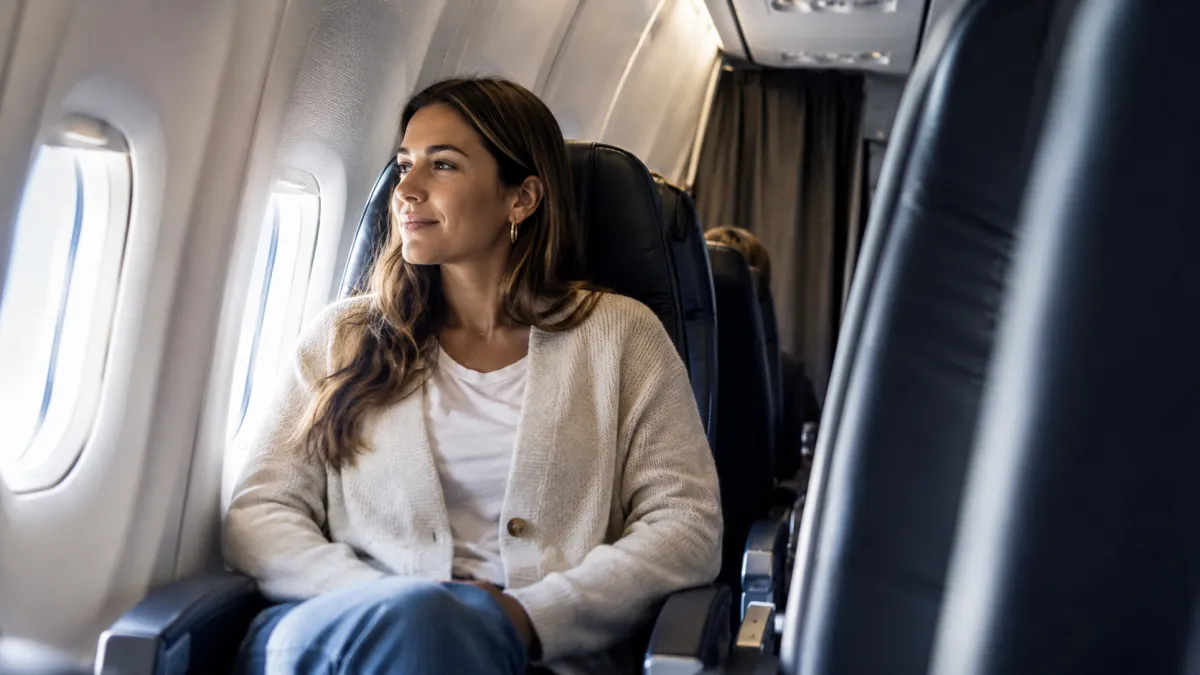
The next few days look different. You have something concrete to do with the anxiety that's building. You feel like you're doing something that actually works with your body.
The night before your flight, you sleep. The morning of the flight, you're still nervous — but you're not arriving already depleted. You have a plan.
You land. And you feel proud. That feeling is the beginning of something different. That feeling is what it's like to stop letting fear decide what your life looks like.
The Only Question Left Is Which Path You Want to Be On
The Fear of Flying Relief Kit is $27. It's available for instant download right now. You can have all four guides on your phone in the next two minutes.
Your next flight is coming. The only question is whether you want to walk onto that plane the same way you always have — or whether you want to walk onto it differently this time.
🔒 Secure checkout. Instant download. 30-day money-back guarantee.
Questions People Ask Before Getting the Kit
Q: I've tried breathing techniques before and they didn't really work for me in the moment. How is this different?
A: That's one of the most common things I hear — and it makes complete sense. Standard deep breathing techniques can be helpful for mild, everyday stress.
But when your nervous system is in a full fear response — the kind that happens on a plane when turbulence hits or the door closes and the anxiety spikes — breathing alone often doesn't reach it.
The tools inside this kit, particularly the bilateral stimulation technique in the Anxiety Spike Reset and the In-Flight Calm Protocol, work differently. They're designed to communicate directly with your nervous system rather than trying to override it from the outside. Many people who felt like breathing techniques simply didn't work for them find that these body-based approaches feel genuinely different — in a way that's hard to fully explain until you experience it yourself.
Q: Do I need to read through everything before my flight, or can I use it in the moment?
A: Both — and the kit is designed for both. The Pre-Flight Reset Plan is meant to be used in the days leading up to your flight, so you're working with your nervous system before the anxiety has a chance to fully build.
But the In-Flight Calm Protocol and the Anxiety Spike Reset are specifically designed to be used in real time — on the plane, in the moment, even if you've never looked at them before. They're written in plain, clear, step-by-step language that you can follow even when your anxiety is already elevated. You don't need to have memorized anything or practiced anything in advance.
You just need to have the guides accessible on your phone and be willing to follow the steps when you need them.
Q: I'm a pretty private person and I don't want to be doing anything on the plane that draws attention. Will these techniques be noticeable to other passengers?
A: No. The techniques inside this kit — including the bilateral stimulation tapping — are subtle enough to use without anyone around you noticing. You can do the tapping on your own legs, on your armrest, or in your lap.
You can follow the In-Flight Calm Protocol by simply reading from your phone, which looks no different from reading anything else. Nothing about using these guides requires you to do anything that would stand out or draw attention. You can work through the entire kit quietly and privately, which is exactly how it was designed to be used.
Q: Will this work if my fear of flying is really severe — not just mild nerves?
A: The tools inside this kit are grounded in body-based, nervous system regulation approaches that are designed for real, significant flight anxiety — not just mild pre-flight nerves. That said, if you're dealing with a clinical anxiety disorder, significant trauma, or a level of fear that is severely impacting your daily life beyond flying, this kit is not a replacement for professional therapeutic support.
It can absolutely be used alongside therapy, and many of the techniques inside are consistent with what trauma-informed therapists use in clinical settings. But if your anxiety is at a clinical level, please also work with a mental health professional. This kit is a practical, real-time support tool — and it works best when you're ready and willing to use it.
Q: I don't have WiFi on my flights. Can I still access the guides in the air?
A: Yes — and this was completely intentional in how the kit was built. The guides are PDF downloads, which means once you've saved them to your phone or device before your flight, you can open and use them at any point without an internet connection.
No WiFi needed. No streaming required. You just need to make sure you've downloaded them before you board, and they'll be there whenever you need them — including at 35,000 feet with no signal.
Q: I'm a man and I feel a little embarrassed that I struggle with this. Is this kit going to feel relevant to me?
A: Completely. Fear of flying doesn't discriminate — and neither does this kit. As a flight attendant, I watched businessmen in suits quietly managing their own terror from the window seat just as often as anyone else.
I watched people who projected total confidence in every other area of their lives grip the armrest and count the minutes until landing. The shame around this fear is real, and it's one of the reasons so many people suffer through it alone instead of getting help.
But the fear itself — and the nervous system response behind it — is the same regardless of who you are. The tools inside this kit work with your body's fear response directly. They don't care about your gender, your background, or how capable you look from the outside. They just work.
Q: What if I buy this and it doesn't help me?
A: Then you get your money back. It's genuinely that simple. Reach out within 30 days of your purchase, let me know, and I'll process your refund. I'm not interested in keeping $27 from someone who didn't find value in what's inside.
I'm interested in helping people actually feel better on planes — and if this kit doesn't do that for you, you shouldn't pay for it. There's no complicated process, no questions designed to talk you out of it, and no fine print designed to make it difficult. Just a straightforward refund.
Q: How quickly will I get access after purchasing?
A: Immediately. The moment your purchase is complete, you'll receive a link to download all four guides. There's no waiting, no shipping, no account to set up, and nothing to install. You can have everything on your phone within minutes of deciding you're ready — which means if you have a flight coming up soon, you don't have to wait to start.
Q: I've had this fear for years. Is it too late for this to actually help me?
A: No. The nervous system is not fixed — it responds to the right input regardless of how long the fear has been present. The people who tend to benefit most from these tools are often the ones who have been carrying this fear the longest — because they've already tried everything else, they've already exhausted the logical approaches, and they're genuinely ready for something that works at the level where the fear actually lives.
How long you've had this fear doesn't determine whether these tools can help you. What determines that is whether you're willing to use them.
🔒 Secure checkout. 🔻 Instant download. 🛡️ 30-day money-back guarantee.
One Last Thing Before You Decide
You've been managing this fear on your own for a long time.
You've gotten good at pushing through.
You've developed your strategies — the window seat, the noise-canceling headphones, the drink at the airport bar, the playlist you put on to distract yourself, the white-knuckling.
You've built a whole system around surviving flights.
And it's worked, in the sense that you've gotten where you needed to go.
But there's a difference between surviving something and actually handling it.
And somewhere underneath all the coping and the pushing through, you know that difference.
Somewhere underneath all of it, there's a version of you who wants to get on a plane and just — GO
Who wants to book the trip without the weeks of dread that follow. Who wants to sit in that seat and feel something other than the desperate need for it to be over.
Who wants to land somewhere and feel present — actually present — instead of just relieved that it's done.
That version of you isn't naive. They're not pretending the fear doesn't exist. They just have tools that work. They know what to do when the fear shows up.
And that knowledge — that simple, practical, body-based knowledge — changes everything about the experience.
This Is What the Fear of Flying Relief Kit Gives You
Not a promise that you'll never feel anxious on a plane again.
That wouldn't be honest, and you deserve honesty more than you deserve a promise that sounds good but doesn't hold up at 35,000 feet.
What it gives you is something more useful than that.
It gives you a way to work with your nervous system instead of fighting against it.
It gives you real tools for the days before your flight, for the flight itself, and for the moments when the fear spikes and you need something that works fast. It gives you the experience of knowing — maybe for the first time — that when the fear shows up, you know exactly what to do.
That's not a small thing. That's the difference between spending the rest of your life surviving flights and actually being able to live the life that requires getting on them.
The kit is $27. It's available right now. You'll have instant access within minutes of purchasing.
Your next flight is coming.
The only question is who you want to be on it.
🔒 Secure checkout. Instant download. 30-day money-back guarantee.
Get The Fear of Flying Relief Kit - Just $27
Get Instant Digital Access
🔒100% Secure 256-Bit Security Encryption
P.S. — The anticipatory anxiety — the weeks of dread that build before a flight even happens — is often harder than the flight itself. It takes up more time, more mental energy, and more of your life than the actual hours in the air.
The Pre-Flight Reset Plan was built specifically for that window. If you've ever lain awake the night before a flight running through worst-case scenarios, or found yourself dreading a trip weeks before you even need to pack — that guide was made for exactly that moment. Don't walk into your next flight without it.